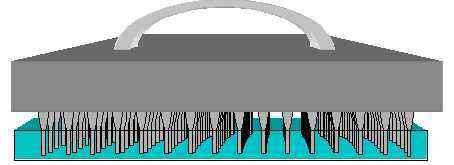
FIGURE 17.1
- Library replication using a hand-held, stainless-steel replicator.
(a) The stainless-steel replicator is placed in a 70% ethanol bath. The replicator is gently moved back and forth through the ethanol to ensure that the pins are thoroughly cleaned. The replicator is removed from the ethanol bath, and the residual ethanol on the pins is ignited by quickly passing the replicator through the flame of a Bunsen burner. Once the alcohol on the pins has burned away, the replicator is allowed to cool for about 2 minutes.
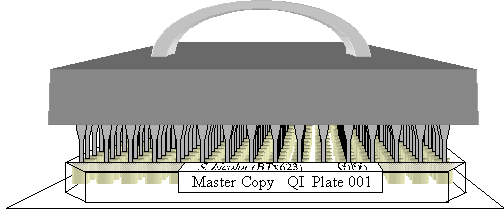
(b) In a laminar-flow hood, the lid is removed from Plate 001 of the master copy. The media in each well of the plate should be turbid due to bacterial growth. The replicator is aligned with the master plate so that each pin of the replicator is directly over an appropriate well. The replicator pins are inserted into the wells.
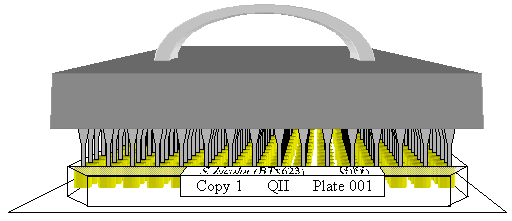
(c) The replicator is inserted into the wells of a plate containing sterile freezing medium. This newly-inoculated plate should be labeled "Copy 1, Plate 001", and the replicator should be inserted into the plate in exactly the same orientation as it was inserted into the master plate. The lid of Copy 1, Plate 1 is replaced, and the plate is set aside.
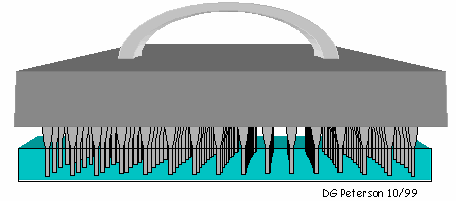
(d) The replicator is re-sterilized as described above.
(e) The replicator is placed back into Plate 1 of the master copy. A second copy of Plate 1 is generated by using the replicator to inoculate the sterile freezing media in the wells of a second plate designated "Copy 2, Plate 001".
(f) Steps a-e are repeated until each plate of the master copy has been twice replicated (i.e., there are three complete copies of the library).